

Gallstones
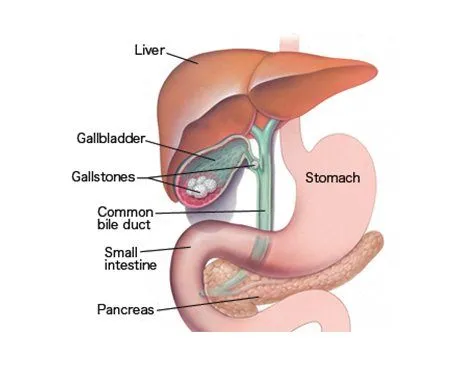
Gallstones are small concretions that form in the gallbladder when a digestive juice called bile forms small crystals. Very tiny stones may cause no symptoms and are often picked up during diagnostic imaging for another issue. Larger stones can cause irritation and even block the gallbladder ducts, leading to pain and possible infection.
Symptoms of Gallstones
Symptom ‘flare-ups’ are often referred to as gallbladder attacks, and they occur most commonly after meals.
Severe pain or throbbing in the upper abdomen, back, or right shoulder blade is a common symptom of gallbladder problems. Some people may also experience a dull ache beneath the rib cage, along with nausea or vomiting. In cases of infection, fever may develop. More serious symptoms can include jaundice, which causes yellowing of the skin and eyes, itching, and dark-colored urine.
How are gallstones treated?
If gallstones aren’t causing symptoms, doctors may recommend a “wait-and-see” approach, with regular monitoring instead of immediate treatment.
When gallstones cause no symptoms, a ‘wait-and-see’ approach may be recommended to monitor the stones and decide if surgery is needed in the future. However, for patients who experience one or more gallbladder attacks, surgery to remove the gallbladder (cholecystectomy) is usually advised. This helps prevent the formation of additional stones and reduces the risk of serious complications such as infection or pancreatitis.
During Gallbladder Surgery
Most gallbladder removals are done laparoscopically, using a few small incisions instead of one large cut. This approach usually means less pain and faster healing.
Gallbladder surgery is usually done laparoscopically through a few small incisions. A camera and instruments are inserted to remove the gallbladder, with gas used to gently inflate the area for better visibility. The incisions are then closed. Most procedures are outpatient, with patients going home the same day and returning to work in about a week.
How Gallbladder Removal Works
The surgeon uses tiny incisions and a camera to remove the gallbladder, usually allowing patients to go home the same day.
The surgeon makes a few small incisions in the abdomen and uses a tiny camera and special instruments to remove the gallbladder. The area is gently inflated with gas for a clear view. Most surgeries are laparoscopic, which means less pain, smaller scars, and a quicker recovery—often with patients going home the same day.
Testimonials
Words from our patients

“I’m a nurse and kind of difficult to deal with… Dr. Nihalani put me at ease on my first visit.”*

“Office staff was experienced and helpful, Dr.Nihalani’s bedside manner was proffesional and refreshing.”*

“Let me just say, this man saved my life…I have lost close to 100lbs and am far from where I was a year ago. I couldn’t thank them all enough.”*

“Dr. Nihalani gave me my life back. He have save my life. I could not walk, and now I walk twice a day and I feel so good and I can play with my grandson again”*
“Dr. Nihalani Paid Special attention and took extra precautions to make me feel at ease with the decision to literally save my life.”*
“Dr Nihalani is a amazing dr and person, I am so grateful to have been lucky enough to end up in his office. He has made my life whole again”*
“Dr Nihalani is one of most caring,genuine surgeons. I have recommended him very highly and will continue to do so.”*
“Dr. Anish Nihalani is a highly-qualified, caring doctor. I would recommend him to anyone who wants a good, compassionate doctor.”*
“Dr Anish Nihalani was my number 1 choose for my gastric sleeve , I have no regrets on getting that surgery”*
“Best Dr by far… he has truelly changed my life!! I would recommend him to anyone who asks!”*
“He is a great doctor, always addressing your concerns, explains everything in detail he is fabulous.”*
Thank you Dr Nihalani for changing my life for the best! You and your staff and very professional and make your patients feel very comfortable with the whole process!”*

“This office has changed my life. Dr. Nihalani, Sara Shama, and the staff have been my guide, mentors and strength on my journey.”*
“Dr. Nihalani is a caring & wonderul Dr. I have lost weight and my self esteem is better. Thank you Dr. Nihalani “*
“Attentive to the patient’s needs by having good listener skills, Treats patient as a family member than a number, relatable with good bedside manner. “*

Our Locations
Choose your preferred location
Frequently Asked Questions
Do gallstones always hurt, or can someone go years without knowing?
A lot of people actually have no idea they have them. The stones can just sit there, not causing any drama. Trouble usually starts when one of them moves into a narrow spot. That movement — not the stone itself — is what sets off the pain. So yes, you can go years without a clue, and then one day it suddenly acts up.
What does the pain really feel like for most people?
People describe it in their own way, but there’s a common theme: a deep, grabbing type of pain under the right ribs that makes you pause whatever you’re doing. Some say it feels like something “stuck,” others feel it pushing toward the back. It’s not that light burning you get from acidity — it’s heavier and harder to ignore.
If I eat healthier, will the stones disappear?
Eating cleaner definitely helps calm things down, but once a stone forms, it usually stays. Food can keep your gallbladder from getting irritated, but it can’t undo what’s already there. Think of it like avoiding traffic — it helps the ride, but the road doesn’t change.
Why do doctors sometimes suggest surgery even if symptoms are mild?
Because gallstones don’t always stay predictable. A person may have mild pain today and a sudden, severe blockage next month. Doctors recommend surgery when they see a pattern starting — not because the pain is huge right now, but because they know where it could go.
Will life feel different after the gallbladder is gone?
Most people settle into a new normal pretty quickly. For a few weeks, your stomach might react faster to certain foods, but the body usually figures things out. After that, people eat, work, and live the same way they did before — minus the surprise attacks.
When should someone stop waiting and get checked immediately?
If the pain keeps climbing instead of easing, or if you notice yellowing eyes, fever, or vomiting that doesn’t let up — that’s a sign something more serious might be brewing. That’s not the time to “wait it out.” That’s the time to be seen.
Contact with us!
Have questions or feedback? Simply complete the contact form below.